Personal Project

Micro-Grid Charging Station Thesis

Can solar + batteries compete with the grid to power autonomous fleets?

100%
Solar Powered
$0.25
Target per kWh
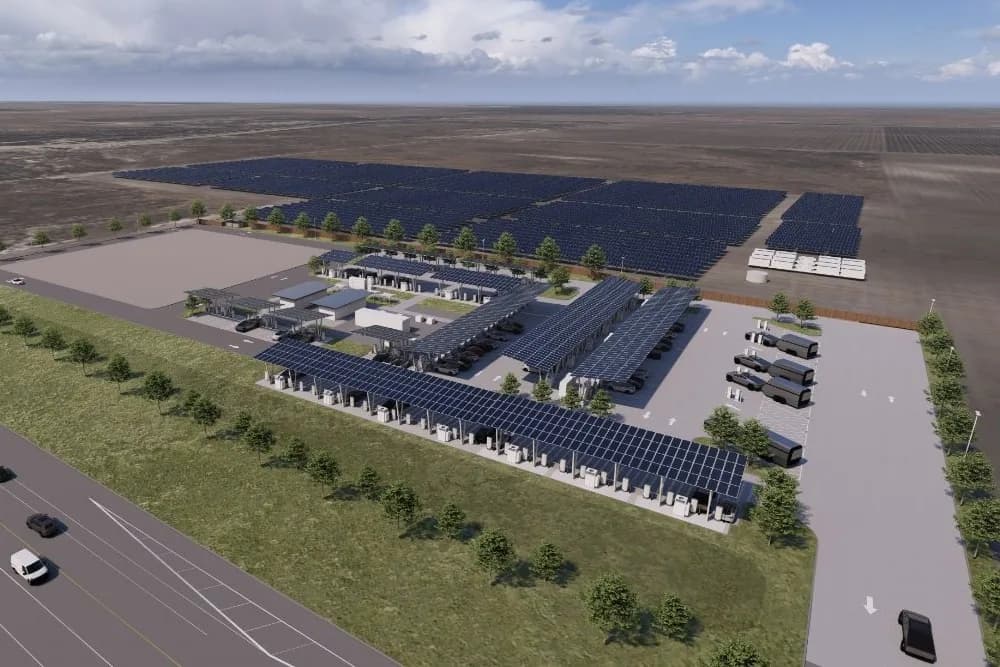
Off-Grid Charging Station Concept

Why This Question Matters

I'm fascinated by how robotaxis will reshape transportation. When you remove the driver, the cost per mile drops drastically. Then the question becomes: How can we make the remaining variables cheaper?

There's another massive cost: energy. For autonomous fleets running 20+ hours a day, electricity cost becomes a major variable.

When looking at California's energy prices, I realized more than half of the cost goes to taxes and grid infrastructure, not generation. The actual generation piece is relatively cheap.

So I asked: what if you could build an off-grid charging station—solar panels, batteries, no grid connection—that offers below-market rates to autonomous fleets?
System Design Methodology

Starting with demand and backing into the infrastructure

1

Demand Calculation

Defining the load profile for a 24-hour autonomous fleet hub

Facility Operations

23 hours/day

Utilization Rate

35%

Active charging time

Power Infrastructure

4 × 1.2 MW

V4 Charging Cabinets

Calculation

23 hrs × 35% × (4 × 1.2 MW) = 38.6 MWh/day

Output

38.6 MWh

Daily Power Demand

2

Battery Sizing

Calculating storage needs to bridge overnight gaps and peak demand

From Step 1

38.6 MWh daily demand

Capacity Per Unit

3.9 MWh

Tesla Megapack

Units Required

7 Megapacks

Total: 27.3 MWh

Output

7 Megapacks

27.3 MWh total capacity

Accounts for depth-of-discharge and safety buffers

3

Solar Array Design

Backing out the required DC capacity from daily energy needs

From Step 1

38.6 MWh demand

NREL Annual Yield

2,628 kWh/kW

Location-specific data

Step 1: Required Generation

38.6 MWh ÷ System Efficiency = 40.5 MWh/day

Step 2: Daily Yield

2,628 kWh/kW ÷ 365 days = 7.2 kWh/kW/day

Step 3: Required DC Capacity

40.5 MWh ÷ 7.2 kWh/kW = 5.6 MW DC

Output

5.6 MW DC Capacity

From here I determined panel count, acreage, and land requirements

Factored: panel efficiency, ground cover ratio, infrastructure buffers

The Pro Forma

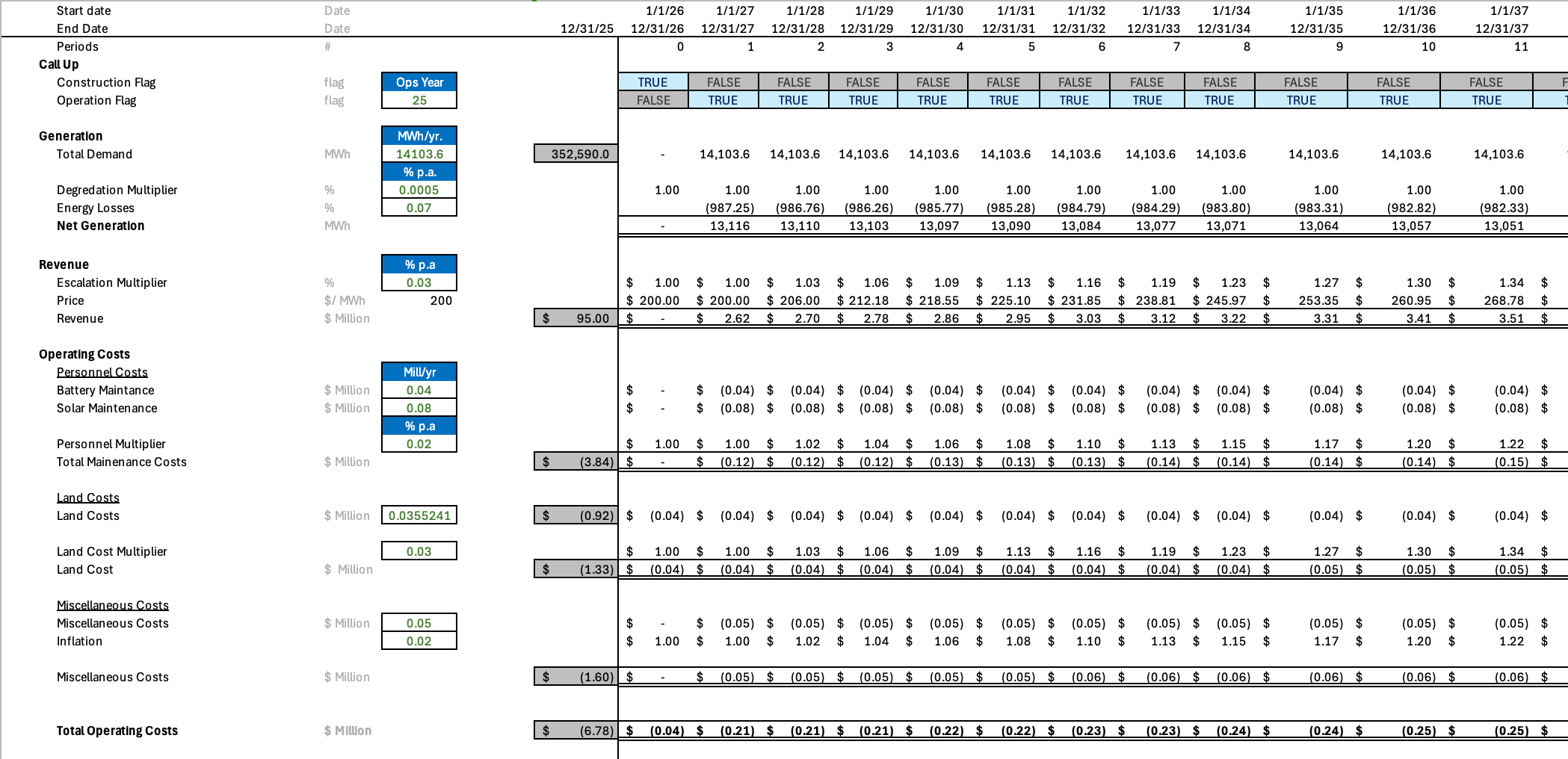
I built a 25-year cash flow model testing if the unit economics can survive without subsidies.

20-Year Financial Model - Cash Flow, NPV, and IRR Analysis

The Inputs

  • 20-Year Straight-line Depreciation
  • 4% Interest Loan Assumption
  • Inflation Escalators for OpEx & Revenue

Operational Reality

  • Degradation modeled for panels & batteries
  • Budgeted for maintenance inflation
  • Ongoing land lease & insurance costs

The Verdict

  • Equity NPV Calculation
  • Internal Rate of Return (IRR)
  • Conclusion: Viable at scale.

Sensitivity Analysis

Identifying the critical thresholds for project viability.

Highlighted Scenarios

Bear Case

Conservative

4.50% Equity Cost × $0.15/kWh

NPV$2.23M
IRR19.67%

Base Case

Expected

4.00% Equity Cost × $0.25/kWh

NPV$11.39M
IRR38.62%

Best Case

Optimistic

3.50% Equity Cost × $0.35/kWh

NPV$20.55M
IRR57.77%

Key Insight

Pricing power leverages returns more significantly than capital cost reductions. A $0.05/kWh increase impacts IRR more than a 0.5% reduction in equity cost.

Project Returns Matrix

BearBaseBest
Cost of
Equity
Price per kWh
$0.15
$0.20
$0.25
$0.30
$0.35
5.00%
$2.04M19.25%
$6.52M28.48%
$11.01M37.72%
$15.50M47.03%
$19.99M56.39%
4.50%
$2.23M19.67%
$6.71M28.92%
$11.20M38.18%
$15.69M47.50%
$20.18M56.86%
4.00%
$2.41M20.08%
$6.90M29.35%
$11.39M38.62%
$15.88M47.95%
$20.37M57.32%
3.50%
$2.60M20.48%
$7.09M29.77%
$11.57M39.06%
$16.06M48.40%
$20.55M57.77%
3.00%
$2.78M20.88%
$7.26M30.18%
$11.75M39.49%
$16.24M48.83%
$20.73M58.21%
*Values represent Equity NPV ($ Millions) / Equity IRR (%)

Conclusion

This was a curiosity project—an exploration into whether off-grid charging could be economically viable for autonomous fleets.

I'm new to the energy space, and this model doesn't include some real-world complexities like permitting, entitlement costs, or development fees. Those soft costs could certainly impact the economics.

But it's a start. As robotaxi fleets scale and utilization rates climb, bringing down the per-mile energy cost becomes critical. This is one potential solution worth exploring further as we navigate the transition to autonomous transportation.

Back to Portfolio